
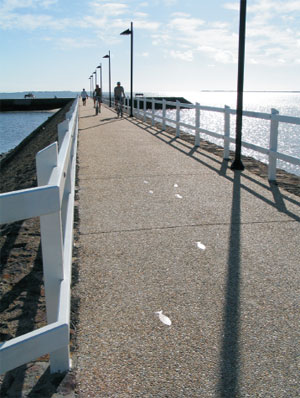
Quandamooka is the Aboriginal name for Moreton Bay, and it is also the name of the people whose country it is. The Quandamooka People are three groups — the Noonuccal, the Goenpul and the Ngugi — and they have looked after this bay, its islands and its shoreline for thousands of years. They are still here.
That last sentence matters, because accounts of Aboriginal history in this district have a habit of stopping somewhere around 1900, as though the story ended. It did not.
Country and language

The Noonuccal hold the northern part of Minjerribah, now also known as North Stradbroke Island. The Goenpul hold the central and southern parts of the same island. The Ngugi hold Moreton Island.
Each group had its own language or dialect, and its own names for places along the bay. Dunwich, for example, was known as Gompee. These were distinct peoples with distinct country, not a single undifferentiated group — a distinction early European accounts routinely missed.
Wynnum takes its name from the pandanus palm, sometimes called the breadfruit tree, known locally as winnam. It is one of the few Aboriginal place names still in use across the district.
Living from the bay
The bay fed people well, and the knowledge of how to read it was detailed and specific.
Men fished and hunted. Dugong was especially prized — the meat roasted and shared, the oil used medicinally and worked into the skin. Fish were speared, caught in nets made from fire vine or the inner bark of the cotton tree, or driven into stone traps built on the beach. Turtle and flying fox were hunted, the latter often on the mainland, reached by canoe.
Women gathered shellfish, vegetables and small game. Fern root was roasted, or pounded into a flour for bread. A drink was made from the fleshy part of the pandanus. Midyim berries, lily bulbs, native honey and the larvae of the Xyleutes moth all had their place. The suckers of the pandanus were used to eat the honey.
One practice deserves its own mention. Along this shoreline, people fished in cooperation with dolphins. Three or four men would wade out to knee or waist depth and clap their spears together, slap them on the water, or push them into the sand to make a squeaking sound. The dolphins — whose hearing is acute — would answer, driving schools of mullet towards the shore and into the waiting nets. Both parties ate.
This was not a folk tale. It was a working method, refined over generations, and it is the reason the artwork on the Wynnum jetty is called Bulka Booangun — Calling the Dolphins.
Camps, ceremony and gathering
People moved between semi-permanent camps rather than living nomadically in the way the word usually implies. Shelters varied with the purpose: simple lean-tos for a night, more substantial huts at regular camps.
Wynnum North was long known as Black’s Camp — a place where people from the islands camped while hunting flying fox, waiting for weather that would let them cross home again. It was also a place where corroborees were held.
Bora rings, where ceremonies took place, stood at Gibson Island, Cleveland and Tingalpa. Groups from across the bay and from inland met at these places. Details of ceremony are held by Quandamooka people, and this account stays deliberately brief.
Tools and making
Boomerangs, shields and other tools were decorated with patterns, burnt or painted on using hair, grass, or a brush made from a softened stick end. Materials were gathered locally or traded with neighbouring groups — dilly bags, for instance, woven from freshwater reeds.
Colonisation
Matthew Flinders sailed into Moreton Bay in 1799. Permanent European settlement of the district began in 1824.
What followed was not gradual. As settlement expanded, Quandamooka people were pushed to the coastal fringes, and many moved to the islands, which were occupied later and less densely. Traditional life persisted longest on Stradbroke Island and around Cleveland.
There was armed resistance, and there was violence. Introduced disease also killed in large numbers, as it did across the continent. Older local histories — including the sources this page draws on — tend to name disease as the principal cause and pass over the violence quickly. That emphasis reflects when those histories were written more than what happened.
In 1897 the Queensland Parliament passed the Aboriginals Protection and Restriction of the Sale of Opium Act, which gave the state sweeping control over where Aboriginal people could live, work and travel, and moved many onto reserves. Its effects ran for decades.
The bay today
The Quandamooka People’s connection to this country is recognised in law, and their traditional owner organisations hold and manage those interests on behalf of the Noonuccal, Goenpul and Ngugi peoples today. Cultural events run across the bay and the islands through the year.
Quandamooka Place, Wynnum jetty

In 2001, local Aboriginal and non-Aboriginal residents began working together on a project to mark the bay’s cultural and environmental heritage at Pandanus Beach and along the Wynnum jetty. The working group brought together the Rotary Club of Wynnum & Manly, the Winnam Aboriginal and Torres Strait Islander Corporation and the Brisbane City Council. Rotary initiated it as its fiftieth anniversary project.
A public design competition in 2002 was won by designer Paul Songhurst, whose concept Bulka Booangun: Calling the Dolphins tells the story of the fishing partnership described above. The works include:
- A five-metre timber and ceramic sculpture at the jetty entrance, built from three recycled hardwood pylons
- Six in-ground ceramic panels, each 2.8 metres wide, set into the jetty deck, with designs drawn from Quandamooka lore
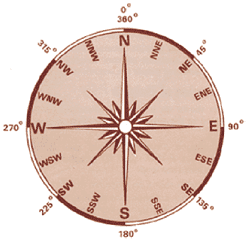
- A two-metre ceramic direction-finder dial at the seaward end, marking visible landmarks around the bay
- A four-metre stainless steel sculpture at the jetty’s midpoint, resembling three spears, commemorating the partnership between Quandamooka people and the dolphins




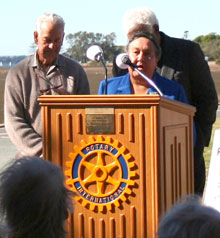
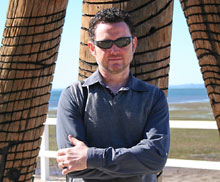
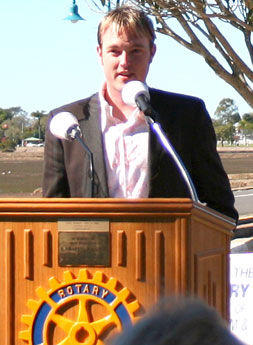
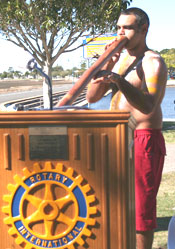
The pathway and entrance sculpture were handed over in July 2005. Aunty Margaret Iselin and Stevon Newton took part in the ceremony alongside the then Lord Mayor.

The jetty carries thousands of visitors a week. Most walk straight past the artwork without knowing what it records.
Sources
Historical photographs and project drawings served from the original Wynnum Manly Online image archive.
- Armstrong, H.W. (1971) The History and Development of the Wynnum District, Brisbane
- Beitz, M.N. (1982) Mangroves to Moorings: The Past 100 Years of Manly, Queensland, Manly Centenary Committee, Brisbane
- Rotary Club of Wynnum and Manly, Quandamooka Wynnum Jetty Art Project: A Celebration of Moreton Bay and its People, Brisbane